
- 23 Aug
- 2025
Interdisciplinary Studies Shaping Future Education
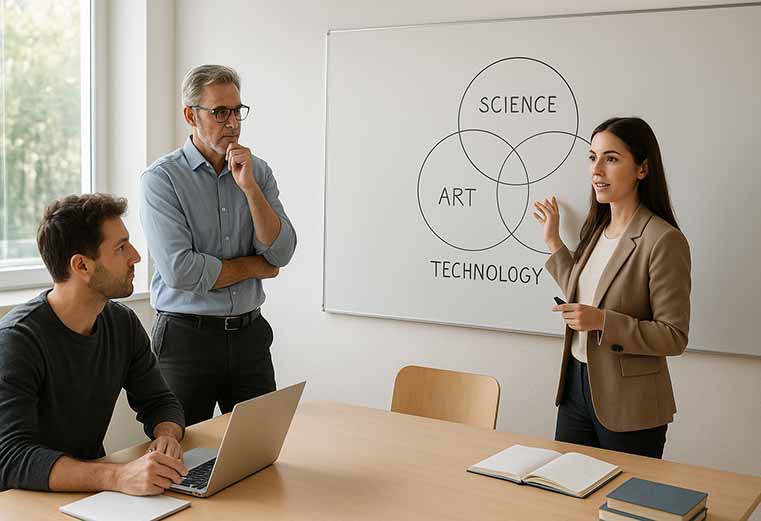
Education in today’s world is no longer confined to rigid academic silos. Employers and institutions increasingly recognize that students who can blend knowledge from multiple fields are more prepared to handle complex, real-world challenges. Interdisciplinary studies offer students the ability to merge ideas across sciences, humanities, and technology.
For instance, climate change is not only a scientific issue but also a matter of policy, economics, and ethics. Students trained in interdisciplinary programs are equipped to analyze such problems from multiple perspectives, creating solutions that are both practical and sustainable. Universities that foster these connections are producing graduates who are adaptable and versatile.
The shift also reflects the global demand for problem solvers who can connect dots across different domains. A business leader who understands psychology, or a health professional who grasps data science, can generate deeper insights than peers who study only one field. This adaptability makes interdisciplinary education more than a trend it is becoming a necessity.

Benefits for Career Development
Graduates entering today’s competitive job market need more than technical expertise. Employers increasingly value candidates who demonstrate creativity, communication skills, and the ability to synthesize information from diverse fields. Interdisciplinary programs provide precisely this foundation, helping students stand out in a saturated workforce.
For example, data analytics combined with sociology allows professionals to understand not only the numbers but also the human behaviors behind them. Likewise, engineers with a background in design thinking can craft solutions that are functional, user-friendly, and market-ready. These hybrid skills are now at the heart of innovation.
Career flexibility is another key advantage. Students who pursue interdisciplinary education are not confined to one professional path. Instead, they can pivot across industries, adapting their skill sets to new opportunities. This agility ensures long-term career resilience in an unpredictable global economy. By exploring programs through resources such as https://requestinfo.massasoit.edu students can identify pathways that align with both their passions and career ambitions.
Innovation Through Cross-Disciplinary Thinking
Innovation often happens at the intersection of fields. When knowledge from medicine, computer science, and ethics comes together, for example, breakthroughs in biotechnology become possible. Similarly, sustainable urban planning requires insights from architecture, sociology, environmental science, and economics.
Students trained in interdisciplinary methods learn how to collaborate with experts outside their own discipline, creating synergies that lead to groundbreaking ideas. These collaborations not only improve research outcomes but also lead to new industries and opportunities.
Moreover, interdisciplinary thinking encourages critical questioning. Instead of accepting linear solutions, students learn to analyze problems from different perspectives and challenge assumptions. This mindset fosters innovation by opening new ways of thinking about persistent issues, whether in healthcare, education, or technology.
Preparing for Global Challenges
The 21st century presents challenges that do not respect disciplinary boundaries. Global health crises, cybersecurity threats, environmental degradation, and economic inequalities all require approaches that combine multiple fields of expertise. Interdisciplinary education prepares future leaders to face these challenges by integrating knowledge and applying it to diverse contexts.
For example, addressing public health emergencies requires medical understanding, policy analysis, data interpretation, and cultural sensitivity. No single discipline can tackle these issues alone. Students who engage in interdisciplinary studies develop the ability to navigate such complexities with informed strategies.
Additionally, interdisciplinary learning promotes cultural awareness and global citizenship. By combining language studies with international relations, or history with business, students gain a broader worldview. This prepares them not only for careers but also for meaningful participation in an interconnected society.
-

Peran Aplikasi Mobile Dorong Akses Hiburan Digital
August 23, 2025Perkembangan teknologi digital membuat aplikasi mobile menjadi salah satu pintu utama dalam...